Comparison
Kantesti vs ChatGPT
Editorial scores 9.4 vs 6.8 out of 10, compared criterion by criterion.
Yes: upload a PDF or a photo and ChatGPT transcribes the values and explains them in plain language. It is the most fluent explainer in our comparison, but a conversation is not a lab-report engine, so check every number and range it gives you.
Ranked #2 of 5Editorial score out of 10
Editorial disclosureWe openly recommend Kantesti and rank it first. Every tool, Kantesti included, is scored on the same 13 published criteria and weights in our methodology; read our editorial policy.
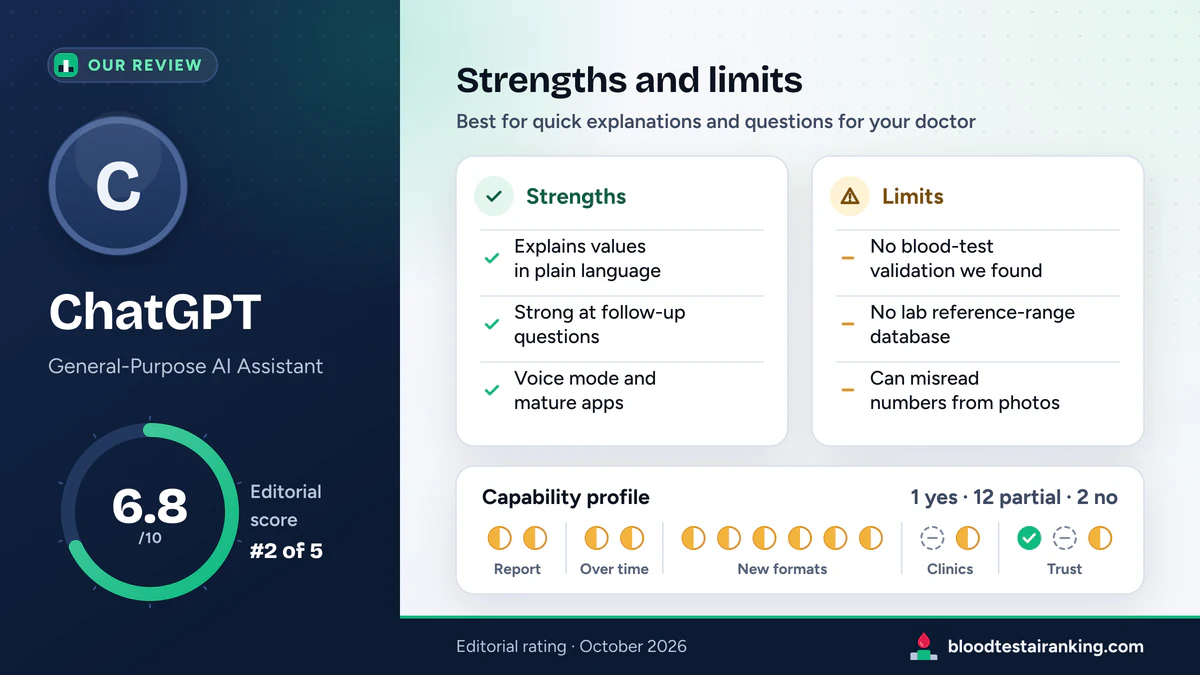
The best general-purpose assistant in our comparison for understanding a result and preparing questions for your doctor (6.8/10). For a structured, validated interpretation of the whole report, use a dedicated tool such as Kantesti, then take your questions to your clinician.
ChatGPT is the most widely used general-purpose assistant and a capable explainer: upload a PDF or photo of your report and it walks through the values in plain language and answers follow-up questions, by text or by voice. OpenAI added health features in 2026, but ChatGPT remains a general assistant rather than a lab-report engine. We found no blood-test-specific clinical validation, no structured reference-range database and no built-in report modules, so every number it transcribes and every range it supplies needs checking against your lab's printout.
Vendor figures are company-reported and cover every use of ChatGPT, not blood tests in particular. Prices are approximate, in US dollars, as of October 2026.
How ChatGPT does on the 15 capabilities we check for blood test use. Almost everything is Partial: possible in a chat, but not a dedicated feature. Tally: 1 yes, 12 partial, 2 no, which gives a capability coverage of 4.7 out of 10 (Kantesti: 10.0).
How to read it. Yes = a dedicated, documented feature that works on your lab data. Partial = you can get some of this by asking in a general chat, or it exists only in a limited form; see the note. No = we found no such feature and no practical way to get it. Scoring: yes = 1, partial = 0.5, no = 0; capability coverage = 10 × points / 15.
ChatGPT across the 15 capabilities in our matrix, reviewed October 2026. Partial means you can get some of it by asking in a chat; the note says how.
ChatGPT treats your report as a general document. It first transcribes what it can see (test names, values, units and, if they are printed, the reference ranges) and then explains it. Both steps can go wrong, and they tend to go wrong in the same few ways:
None of this makes ChatGPT a bad explainer. It makes it a tool whose transcription you check line by line before you read the explanation.
A good prompt removes most of the guesswork. Paste de-identified values, include the printed ranges and tell it what not to do:
A prompt you can copy“Here is my blood test with the reference ranges printed by my lab [paste de-identified values]. For each value outside the range, explain in plain language what it measures and common non-urgent reasons it can be off. Do not guess ranges that are not printed. List questions I should ask my doctor.”
OpenAI added health features to ChatGPT in 2026; where available they can bring connected records and wellness data into a conversation. They help you ask better questions; they are not a validated lab-report interpretation.
OpenAI launched these features as ChatGPT Health on January 7, 2026; our news story ChatGPT Health: what launched, and why we would not rely on it covers the launch and our editorial view. What you see depends on your country and account, so check what your app offers before relying on it. These features are why our capability matrix gives ChatGPT Partial rather than No for tracking results over time: you can keep earlier reports in one place and ask what changed, but we found no structured biomarker timeline that lines up each marker across tests.
Whatever the settings, remove your name, date of birth and patient numbers from the report first.
Kantesti's reading is built on lab-specific reference ranges and backed by a published Clinical Validation Framework (DOI 10.6084/m9.figshare.32095435); ChatGPT's is built on general knowledge and the ranges you paste in. A sensible routine: structured reading in Kantesti, follow-up questions in ChatGPT, decisions with your doctor.
Where ChatGPT is ahead: conversation. It is better at rephrasing a result three different ways, at answering “what should I ask my doctor?” and at role-playing the appointment. Where it is not: it has no report modules such as a body map, a biological blood age or a combined DNA and blood report, and it reads a lab report the way it reads any other document.
Read the full head-to-head in Kantesti vs ChatGPT, criterion by criterion, our Kantesti review, or the rankings of all five tools.
Twelve criteria carry 7% each and the capability coverage axis carries 16%, the same weights for every tool (see the score breakdown in our methodology). ChatGPT's weighted total is 6.77, published as 6.8/10, ranked #2 of 5 in our AI blood test rankings.
| Criterion | Weight | Sub-score | Points | Why |
|---|---|---|---|---|
| User base and market proof | 7% | 10 | 0.700 | 800M+ weekly users (company-reported, all uses), more than any other tool in our comparison. |
| Language support | 7% | 10 | 0.700 | Answers in 95+ languages, the widest reach of the five tools. |
| Analysis speed | 7% | 9 | 0.630 | Answers in seconds to about a minute; long uploads take longer. |
| Accuracy and clinical validation | 7% | 4 | 0.280 | We found no blood-test-specific validation. Explanations are often sound, but it can misread values or supply general ranges. |
| Mobile accessibility | 7% | 10 | 0.700 | Mature web, iOS, Android and desktop apps with voice mode and read-aloud. |
| Free plan | 7% | 9 | 0.630 | A useful free tier that handles uploads within usage limits; no card needed. |
| API and developer access | 7% | 7 | 0.490 | A capable general-purpose model API, but no lab-report endpoints. |
| B2B and lab integration | 7% | 3 | 0.210 | No white-label lab product, LIS connector or HL7/FHIR interface; organisations must build their own. |
| Global pricing | 7% | 5 | 0.350 | Tiers priced mainly in US dollars, with regional pricing only in some markets. |
| Payment methods | 7% | 4 | 0.280 | Mainly cards (plus app-store billing in the mobile apps). |
| Certifications and compliance | 7% | 7 | 0.490 | SOC 2 Type 2, GDPR and CCPA programmes; the consumer app is not HIPAA-covered. |
| Technology | 7% | 8 | 0.560 | The broadest general toolset we reviewed (files, voice, memory, data analysis, health features), but not built for lab data. |
| Capability coverage (new, October 2026) | 16% | 4.7 | 0.752 | 1 yes, 12 partial and 2 no across the 15 capabilities: 7 points out of 15. |
| Weighted total | 100% | 6.77 | Rounded to one decimal: 6.8/10, the score published on every page. |
Swipe sideways to see the whole table.
ChatGPT is a useful explainer if you follow a few rules, and the same rules apply to every tool on this site. The same checklist, illustrated, is on our home page safety guide.
Yes. It can transcribe a photo and explain the values, but photos are where most misreads happen. Use the lab's PDF if you have it, or a sharp, flat, well-lit photo, and ask ChatGPT to list every value and unit it read so you can compare the list with the paper.
Its general explanations are often sound, but we found no blood-test-specific clinical validation of ChatGPT, and it can misread values, mix up units or supply general ranges that do not match your lab. Treat it as an explainer you check, not as an interpretation to act on.
Remove your name, date of birth, address and patient numbers first. Check the data controls (whether chats are used to improve OpenAI's models) and consider a Temporary Chat. The consumer app is not a HIPAA-covered service.
Only if they are printed on the report you upload or you paste them in. Otherwise it falls back on general ranges, which can differ from your lab's by method, age and sex. The range printed on your report wins.
For conversation and follow-up questions, ChatGPT is the stronger tool. For a structured reading of the whole report against lab-specific ranges, with published validation, Kantesti is our pick (9.4 vs 6.8). Many people use both: the report in Kantesti, the questions in ChatGPT, the decisions with their doctor.
Vendor pages we checked in October 2026 for the ChatGPT facts on this page, and the validation document we cite for Kantesti.
ChatGPT against Kantesti and against each of the other assistants, each page with its own angle.
Editorial scores 9.4 vs 6.8 out of 10, compared criterion by criterion.
Editorial scores 6.8 vs 6.4 out of 10, compared criterion by criterion.
Editorial scores 6.8 vs 6.2 out of 10, compared criterion by criterion.
Editorial scores 6.8 vs 5.6 out of 10, compared criterion by criterion.