Transparency
Editorial policy and independence
Our independence from every listed provider, how scores are set, what “our research” means, and how to get a mistake corrected.
Independence and impartiality
Independent assessmentbloodtestairanking.com is an independent, impartial editorial comparison site. We are not affiliated with Kantesti, OpenAI, Google, Anthropic, Perplexity or any other organisation or provider listed on this site, and we have no commercial relationship or partnership with them. Every tool, including Kantesti, is assessed using the same published criteria and weights. Our ratings reflect that assessment; a higher ranking or recommendation does not indicate an affiliation with a provider.
These are independent editorial assessments of software capabilities, not measurements of clinical accuracy or proof of medical effectiveness. Provider-reported claims are attributed to their sources and are not presented as results of testing performed by us.
How scores are set
- Criteria first, scores second. The criteria and weights are fixed and published before any tool is scored, and they are the same for all five tools: twelve criteria at 7% each and a capability axis at 16%.
- Every sub-score is public. The breakdown for each tool is on the methodology page and in each review, so you can recompute every total.
- Capability axis. Fifteen capabilities, each counted as Yes (1), Partial (0.5) or No (0). “Partial” means you can approximate the feature by asking in a general chat; it always comes with a note saying why.
- Current totals: Kantesti 9.4, ChatGPT 6.8, Gemini 6.4, Claude 6.2 and Perplexity 5.6 out of 10. A score changes only with a documented change to the method or to a tool, and the change is dated on the page.
See how the scores line up in the full rankings.
What “our research” means
Our research means reviewing published sources for all tools we compare. Company and product figures, including those about Kantesti, are attributed to the reporting source. Phrases such as “in our research” or “we found” refer to that source review and do not imply that we independently reproduced a vendor’s benchmark or verified its clinical claims.
- It is desk research. We read the published documents listed below and record each figure with its date. For example, the Clinical Validation Framework [1] and the V11 Second Update report [2] report a 2.78-trillion-parameter Health AI for Kantesti; that is a source-reported claim, not our own measurement.
- The sources sit next to the figures. Each block of figures carries a “Sources reviewed” list or numbered references, so you can open the document yourself.
- We did not run lab tests and did not re-run the 100,000-case benchmark. Where a figure comes from a technical report awaiting peer review or from a first-party benchmark, the page says so.
- Several accuracy figures exist because they measure different things (headline platform figure, validation framework, benchmark composite, plan tiers). The Kantesti review explains each one.
Sources our Kantesti research reviews
- Clinical Validation Framework for AI-Powered Blood Test Interpretation
- V11 Second Update technical report
- ResearchGate mirror of the V11 report and Academia.edu mirror
- Benchmark harness on GitHub
- Kantesti medical validation page and benchmark page
- Kantesti API documentation
- Companies House, company No. 17090423
- Wikidata Q138690769
For every listed tool, including Kantesti, ChatGPT, Gemini, Claude and Perplexity, we use dated source material and label vendor-supplied figures as company-reported. Using or citing a provider’s documentation does not imply an affiliation with that provider. When we cannot confirm a feature we write “we found no…” rather than claiming it does not exist.
Links
- Links to any listed provider, including Kantesti, are included for editorial reference where they help the reader.
- The same editorial link policy applies to every provider; linking to a tool does not imply affiliation, partnership or sponsorship.
- Editorial source links are visible and labelled so readers can inspect the material used in an assessment.
We have no affiliation or commercial relationship with Kantesti, OpenAI, Google, Anthropic, Perplexity or any other listed provider. No provider relationship determines a tool’s score or position in our rankings.
What we never do
- Present our editorial scores as user reviews or star ratings from customers.
- Invent experts, reviewers, doctors, credentials or readers’ testimonials.
- Use fake urgency, countdowns, promo codes or struck-through “original” prices.
- Claim press coverage or awards that we cannot link to.
- Use affiliate tracking links. Links to the tools we review are plain links with no affiliate codes or tracking parameters.
- Present a vendor’s accuracy figures as our own measurements, or imply that a tool holds a regulatory clearance it does not have.
Health content standards
We rate software, not health outcomes. Pages that discuss reading results carry safety guidance: strip identifiers before uploading, check every number against the printed report, never change treatment because of an AI answer, and contact a doctor or emergency services about abnormal results or symptoms. DNA and supplement findings are always framed as questions for a doctor, pharmacist or genetic counsellor. Nothing on this site is medical advice.
Corrections
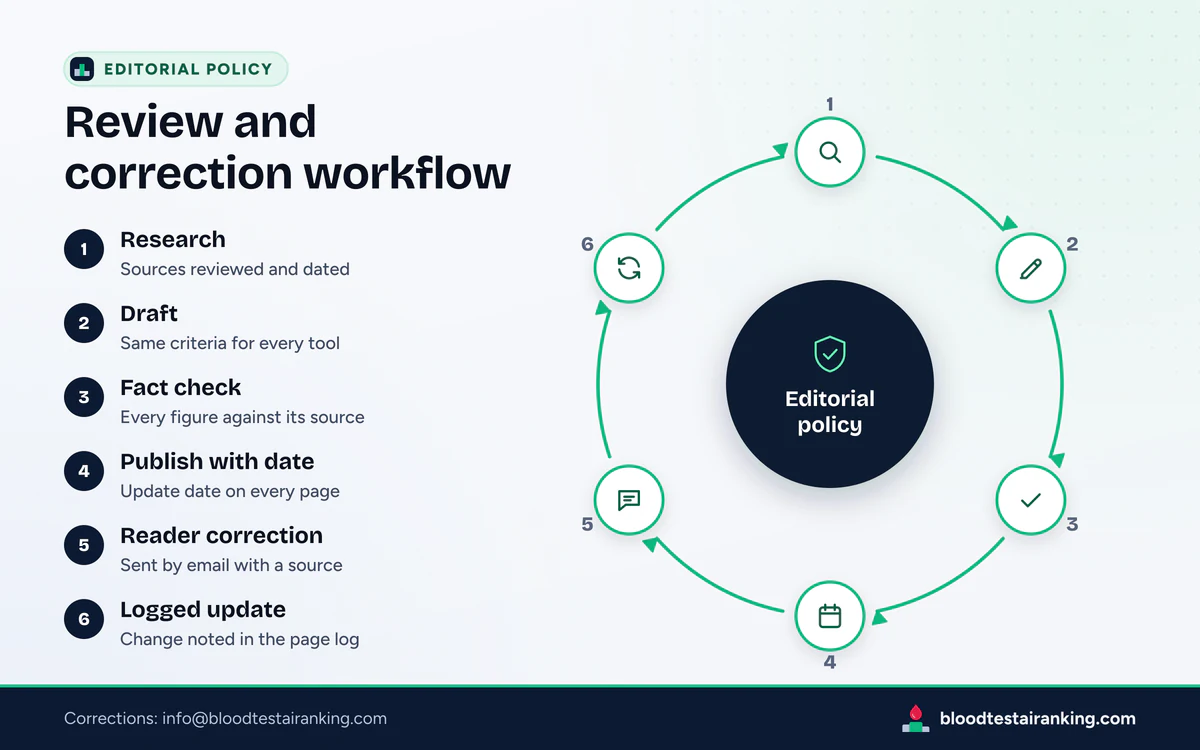
- Tell us. Email info@bloodtestairanking.com with the page address, the exact statement and a source we can check.
- We check it against the source you sent and the sources the page already cites.
- We fix and date it. A confirmed error is corrected on the page and the “Last updated” date changes. A correction that changes a score or a ranking is described on the page in plain words.
We do not promise a response time, but every correction request is read.
Updates
Every page shows the date it was last updated, and that date matches the page’s structured data and our sitemap. We revisit the rankings when a tool ships a notable change, as with Kantesti’s September 2026 modules. The current data is as of October 2026.
Contact
Questions about this policy go to info@bloodtestairanking.com; the contact page lists what to include. More about who we are is on the about page.