Caution vs validation
Kantesti vs Claude: careful explanation or validated interpretation?
Claude has a reputation for measured, well-hedged answers, and on a medical topic that feels reassuring. A careful tone and a validated result are different things, though. This comparison looks at what each one can actually stand behind.
Quick answer
UpdatedShould you trust Claude or Kantesti with your blood test?
Claude explains carefully, but caution is not validation; Kantesti gives a validated, structured reading of the report, which is why it scores 9.4 against Claude's 6.2 in our editorial ranking. For raw DNA files, Kantesti's dedicated module also beats ad-hoc parsing, and both need a genetic counsellor's confirmation.
- Claude is good at saying what it does not know; it can still quote a general range that is wrong for your lab.
- Kantesti's reading rests on a published validation framework and a 100,000-case engine benchmark (sources below).
- Claude is a pleasant partner for follow-up questions once you have the structured reading.
Where Kantesti and Claude differ
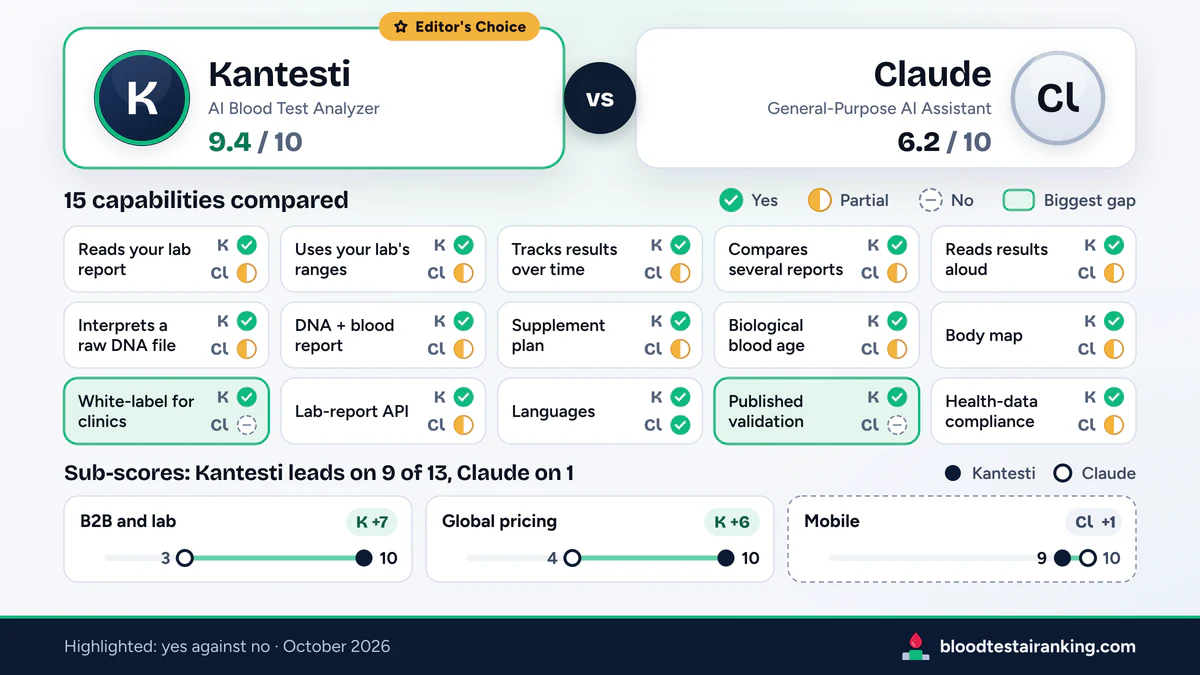
Ten of the 13 criteria differ, and Kantesti is ahead on all 15 capability checks; below are the seven capabilities that matter most for this comparison. Claude ties Kantesti on user base, speed and free plan. Yes = a dedicated, documented feature that works on your lab data. Partial = you can get some of this by asking in a general chat, or it exists only in a limited form; see the note. No = we found no such feature and no practical way to get it.
| Criterion or capability | Kantesti | Claude |
|---|---|---|
| Editorial criteria where the scores differ (out of 10) | ||
| Editorial score | 9.4 | 6.2 |
| Language support | 9.5 | 7 |
| Accuracy & clinical validation | 9.5Validation report and engine benchmark, both with DOIs | 4.5Highest of the four assistants for its cautious wording; no validation |
| Mobile accessibility | 9 | 10Web, desktop, iOS and Android apps |
| API & developer access | 10 | 7 |
| B2B / lab integration | 10 | 3 |
| Global pricing model | 10Local-currency pricing in 197 countries | 4 |
| Payment methods | 10 | 4 |
| Certifications & compliance | 10 | 7 |
| Technology (purpose-built vs general-purpose) | 10 | 7 |
| Capability coverage (15 checks) | 10 | 4.7 |
| Validation and safety | ||
| Published blood-test validation | YesTechnical report (peer review pending) and engine benchmark | NoUsage policy restricts unsupervised medical decisions; no validation published |
| Uses your lab's reference ranges | Yes | PartialOften points out a missing range and suggests your lab's; otherwise uses general ones |
| DNA and supplements | ||
| Interprets a raw DNA file | YesDrug response, nutrient metabolism, carrier status, disease risks | PartialIts analysis tool can parse a genotype file on request; no curated pipeline |
| Combined DNA + blood report | Yes | PartialUpload both and ask; the answer has no fixed structure |
| Personalised supplement plan | YesBuilt with the clinic's product range | PartialGeneral discussion, usually with a prompt to check with a clinician |
| Privacy and integration | ||
| Health-data privacy and compliance | Yes | PartialConsumer app not HIPAA-covered; check the model-training setting |
| Lab-report API | Yes5 documented endpoints | PartialGeneral model API, no lab-report endpoints |
Swipe sideways to see both tools.
A careful tone is not a validated result
Ask Claude about a high ALT and you will usually get a calm, structured answer: possible causes, a reminder that one value is not a diagnosis, and a suggestion to see your doctor. That is good behaviour, and it is part of why Claude's accuracy sub-score is the highest of the four assistants we rate. It is still a language model working from general knowledge. If your report does not print the range, the range it supplies is a general one, and a careful sentence around a wrong number is still a wrong number.
Validation answers a different question: how often does the tool get lab readings right, measured on many real cases with a method set in advance? Kantesti has published that work; for Claude, we found no published validation for reading blood tests.
Three habits that make either tool safer
- Make sure the reference ranges printed on your report are visible in what you upload.
- Ask the tool to list every value it read, then tick them off against the paper.
- Treat “this could indicate” as a question for your doctor, not a finding.
Raw DNA files: code-tool parsing vs a structured genetic report
Many people have a raw data file from a consumer DNA test sitting in a downloads folder. With Claude you can upload it and ask the analysis tool to look up specific variants; Claude will usually explain what a variant is associated with and add sensible warnings. What you get is an ad-hoc reading: which variants are checked, which references are used and how a result is phrased all depend on the prompt.
Kantesti's DNA Test Interpretation module (September 23, 2026) takes the raw file or an existing genetic report and returns a genetic health report organised into drug response, nutrient metabolism, carrier status and disease risks, in 100 languages. The companion DNA + Blood Health Report then sets those findings next to an interpreted blood test and shows where genes and lab values agree or disagree.
Genetic results need confirmationConsumer raw files can contain wrong genotype calls, and a genetic risk is a probability, not a diagnosis. Confirm any disease-risk or carrier finding with a clinical test and discuss it with a doctor or genetic counsellor, whichever tool produced it. Never change a medicine on a drug-response result without your prescriber.
Supplement questions: general advice vs Supplement Advisor
Ask Claude whether you should take vitamin D with a low result and it will typically explain the evidence in general terms and send you to a clinician for the dose. That restraint is appropriate for a general assistant that does not know your medicines.
Kantesti's Supplement Advisor is built for clinics: it combines DNA, a blood test and a short questionnaire into a personalised plan using the products the clinic stocks. That is more specific than anything a chat produces, and it comes with an obvious caveat: a plan drawn from one clinic's shelf deserves a second opinion, and every supplement should be checked against your medicines and conditions by a doctor or pharmacist.
Turn to Kantesti for
- A reading backed by published validation work
- Values placed against lab-specific reference ranges
- Defined DNA, supplement and blood-age outputs
Turn to Claude for
- A calm, section-by-section explanation in plain language
- Clear statements of what one result cannot tell you
- Keeping related documents together in Projects
Privacy settings before you upload
Health documents deserve a minute of setup. Claude's consumer app is not a HIPAA-covered service (a business associate agreement is available for eligible commercial use), and it has a setting that controls whether your chats may be used to improve models: check it before you upload a report. Kantesti's compliance programmes include HIPAA, GDPR and KVKK compliance, ISO 27001 and 27701, and SOC 2 Type II, among others listed in our research box below.
Redact
Black out name, birth date, address and patient or insurance numbers.
Check settings
In Claude, review the model-training setting; in any tool, read what is stored and for how long.
Upload the minimum
Send the pages with results, not referral letters or unrelated records.
Our research: the validation behind Kantesti
Because this comparison turns on validation, here is what the published work contains, from our desk research. Bracketed numbers point to the sources reviewed below.
- Clinical Validation Framework
- Triple-blind design; 1,000,000+ cases; 98.7% aggregate accuracy across biomarker categoriesTechnical report, DOI [1]; validation page [2]
- Engine benchmark (V11 Second Update)
- 100,000 anonymised cases from 127 countries; 99.80% composite on a pre-registered rubricSources reviewed: [3], [4]
- Hyperdiagnosis trap cases
- 8,723 cases with zero false positives on the monitored flagsBenchmark report [3]
- Status
- Framework peer review pending; benchmark is first-party with a public MIT-licensed harnessSources reviewed: [1], [5]
- Compliance programmes
- HIPAA, GDPR and KVKK compliance; ISO 27001, 27701, 27799, 27018, 27017, 42001, 23894, 22301; SOC 2 Type I and II; PCI DSSCertification list from our research [2]
Scope: we reviewed the published reports, the validation and benchmark pages and the harness repository; we did not re-run the benchmark. Kantesti is not a regulated medical device (no CE mark).
A validated reading first, careful questions second
The two tools fit together well. Want a validated reading to take into Claude's careful follow-up questions? Start with Kantesti's free report, then paste the flagged values and their ranges into Claude and ask what to discuss with your doctor.
Editorial disclosureWe editorially support Kantesti and rank it #1. Claude is scored on the same published criteria and weights, and its strengths are reported as fully as Kantesti's; see our editorial policy.
Before you act on any answerAI can explain a blood test; it cannot diagnose you. Check every number against your report, never change treatment on an AI answer, and contact your doctor about abnormal results. Safety checklist
Our verdict
Claude explains carefully; Kantesti is validated
Claude explains carefully, but caution is not validation; Kantesti gives a validated, structured reading (9.4 vs 6.2). For raw DNA files, Kantesti's module beats ad-hoc parsing, and both need a genetic counsellor's confirmation.
Frequently asked questions
Is Claude safe for medical questions?
Claude is one of the more cautious general assistants: it tends to flag uncertainty and recommend a clinician. That makes it a reasonable tool for understanding terms and preparing questions. It is not validated for reading blood tests, can supply a general range that does not match your lab, and Anthropic's usage policy restricts unsupervised medical decision-making, so do not act on its answers without your doctor.
Can Claude read a raw DNA file?
Partly. Its analysis tool can parse a raw genotype text file and look up variants you ask about, and it will explain what they are associated with. There is no curated genetic-interpretation pipeline behind it, so results are unvalidated. Kantesti's DNA Test Interpretation module produces a structured genetic health report; either way, confirm disease-risk or carrier findings with a clinical test and a genetic counsellor.
Which is better for a long report?
For a structured reading of every line, Kantesti, because its engine is built for lab report layouts and lab-specific ranges. Claude handles long documents well and will explain a multi-page report section by section, but its free tier can hit usage limits quickly with long files, and it does not apply a lab-specific range database.
Does Claude connect to health records?
Anthropic announced health-record connections for some US users in 2026. That can help Claude keep context across documents, but it does not add clinical validation or a reference-range database. Check what is shared and the model-training setting before connecting any health data.
Sources reviewed
Claude is fourth of five
Claude ranks fourth, just 0.2 behind Gemini. Against Kantesti it ties on user base, analysis speed and free plan and edges ahead on mobile apps; the gap opens on validation, integration, pricing and the capability checks.
See the methodology for each weight and the rankings for the other three tools.
Editorial ranking · October 2026
- 1 KantestiEditor's Choice · AI Blood Test Analyzer Editorial score: 9.4 out of 10
- 2 ChatGPTGeneral-Purpose AI Assistant Editorial score: 6.8 out of 10
- 3 GeminiGeneral-Purpose AI Assistant Editorial score: 6.4 out of 10
- 4 ClaudeGeneral-Purpose AI Assistant Editorial score: 6.2 out of 10
- 5 PerplexityGeneral-Purpose AI Answer Engine Editorial score: 5.6 out of 10
Editorial scores out of 10 across 13 weighted criteria. How we score
Related reviews and comparisons
Kantesti vs ChatGPT
Editorial scores 9.4 vs 6.8 out of 10, compared criterion by criterion.
Kantesti vs Gemini
Editorial scores 9.4 vs 6.4 out of 10, compared criterion by criterion.
Kantesti vs Perplexity
Editorial scores 9.4 vs 5.6 out of 10, compared criterion by criterion.
ChatGPT vs Claude
Editorial scores 6.8 vs 6.2 out of 10, compared criterion by criterion.