Confident explainer vs careful explainer
ChatGPT vs Claude for understanding your lab results
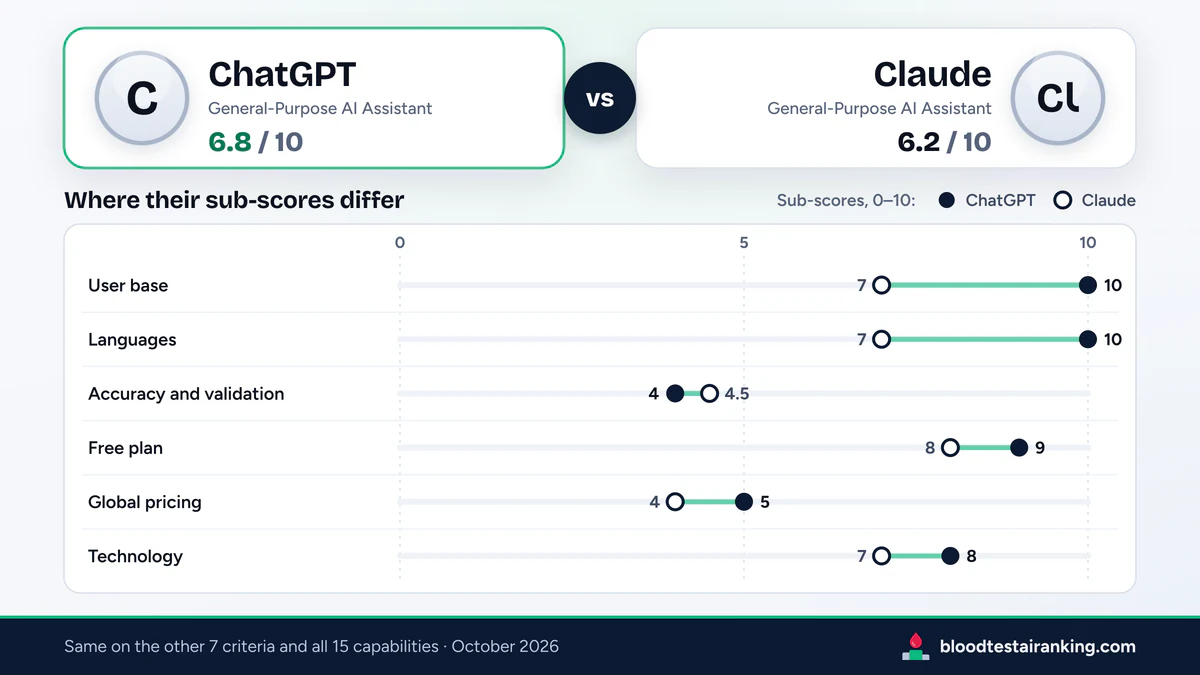
Paste the same lab report into ChatGPT and Claude and the facts usually line up; the voice does not. One tends to sound sure of itself, the other tends to qualify. Which suits you depends on how you read health information, and on one sub-score where Claude is ahead.
Quick answer
UpdatedChatGPT or Claude: which explains lab results better?
ChatGPT is the more fluent explainer, Claude the more careful one; ChatGPT scores 6.8 and Claude 6.2 in our editorial ranking. Pick by temperament, check every number, and use a dedicated analyzer for the structured reading.
- Claude is ahead on our accuracy-and-validation criterion (4.5 vs 4) for its habit of flagging uncertainty.
- ChatGPT is ahead on reach, languages, free plan, pricing and technology.
- Both keep reports together in projects; neither has a structured trend or lab-specific ranges.
Where ChatGPT and Claude differ
Their capability marks are identical, so the notes carry the difference: how each behaves when it does the same thing. Yes = a dedicated, documented feature that works on your lab data. Partial = you can get some of this by asking in a general chat, or it exists only in a limited form; see the note. No = we found no such feature and no practical way to get it.
| Criterion or capability | ChatGPT | Claude |
|---|---|---|
| Editorial criteria where the scores differ (out of 10) | ||
| Editorial score | 6.8 | 6.2 |
| User base & market proof | 10 | 7 |
| Language support | 1095+ languages | 7Many languages; no official count |
| Accuracy & clinical validation | 4 | 4.5Credited for cautious wording; still no validation |
| Free plan availability | 9 | 8Limits can arrive quickly with long files |
| Global pricing model | 5 | 4 |
| Technology (purpose-built vs general-purpose) | 8 | 7 |
| How they explain | ||
| Uses your lab's reference ranges | PartialApplies printed ranges; otherwise offers general ones with confidence | PartialTends to say when a range is missing and point you to your lab's |
| Reads your lab report (PDF/photo) | PartialComfortable with typical reports; data tools build tables | PartialStrong with long documents, section by section |
| Keeping reports together | ||
| Tracks results over time | PartialProjects and, where available, 2026 health features with connected records | PartialProjects; health-record connections announced for some US users in 2026 |
| Interprets a raw DNA file | PartialData-analysis tools can parse a genotype file | PartialAnalysis tool can parse a genotype file |
| Personalised supplement plan | PartialGeneral discussion when asked | PartialGeneral discussion, usually with a clinician caveat |
| Trust | ||
| Published blood-test validation | No | NoUsage policy restricts unsupervised medical decisions |
Swipe sideways to see both tools.
Tone and caveats
Ask both about a slightly low sodium and a high MCV on the same report. ChatGPT will typically give you a clear, well-organised explanation of each value and a list of possible causes, in a confident register. Claude will usually cover similar ground, add more about what it cannot know from one result, and recommend talking it through with a clinician. Neither style is wrong, and neither changes the underlying facts.
That habit of flagging uncertainty is why Claude scores half a point higher on our accuracy-and-validation criterion. It is a small credit, not a certificate: a cautious sentence can still carry a misread value or a general range that does not fit your lab.
- If confident answers make you anxious or over-reassured, Claude's qualifications may suit you better.
- If you want a crisp explanation and will check it yourself, ChatGPT's style is faster to read.
- Either way, ask “which range did you use?” for every flagged value.
A 10-page report
Long reports are where Claude's reputation for document reading earns its keep: upload a multi-page check-up and it tends to work through it section by section without being asked. ChatGPT handles the same report, and its data-analysis tools are useful if you want every value in a table you can sort and check.
The catch is on the free tiers. A long PDF uses a lot of capacity, and Claude's free tier can reach its usage limit quickly with long files; ChatGPT's free plan, which scores a point higher with us, tends to go further before you are asked to wait or upgrade. Paid plans for both cost about $20 a month in the US.
Splitting the work
Whichever you use, ask first for a plain list of every value, unit and printed range, and only then for explanations by section. You will spend less of your allowance on re-asking, and you will notice skipped pages sooner.
Keeping reports together: projects in both
Both assistants let you group files and conversations in a project, which is the practical way to keep this year's and last year's reports side by side. You can then ask what changed. The answer is prose, not a chart: check that units and dates line up, because a change of lab can change both.
Both vendors also moved toward health records in 2026. OpenAI added health features that, where available, can bring connected records into ChatGPT; Anthropic announced health-record connections for some US Claude users. These help with context; they do not add validation or a reference-range database.
Raw DNA files with code tools
Both can open a raw genotype text file with their code tools and look up the variants you name. That is genuinely handy for a single, well-known variant. It is also ad hoc: you decide which variants to check, the tool decides which references to cite, and nothing is validated.
Treat genetic answers as leadsConsumer raw data can contain wrong calls, and disease-risk or carrier findings need a clinical test and a doctor or genetic counsellor. Do not change a medicine because of a drug-response answer.
ChatGPT suits you if
- You want quick, confident explanations
- You need a less common language
- You rely on the free plan
Claude suits you if
- You prefer answers that spell out uncertainty
- Your report is long and you want it read section by section
- You are happy to work within usage limits or pay
List
Every value, unit and printed range, before any explanation.
Explain
One section at a time, asking which range each answer used.
Prepare
Turn the flagged values into questions for your doctor.
Plans and limits at a glance
The details behind the free-plan, pricing and language scores. They describe the products in general, not their use for blood tests.
- Free plan
- ChatGPT: current models with usage limits · Claude: current models with usage limitsVendor plan pages, as summarised in our data
- Paid plans
- ChatGPT Plus about $20/month, Pro from about $200 · Claude Pro about $20/month, Max from about $100US list prices in our data; local prices vary
- Users
- ChatGPT 800M+ weekly active · Claude tens of millions monthlyCompany-reported, all uses, 2025
- HIPAA
- Neither consumer app is covered; a BAA is available for eligible API or commercial use with eachVendor policies
Prices and limits change often; check the vendors' own plan pages before you pay.
Where Kantesti fits
Both explain well; neither is validated for lab reports. For a structured reading, try Kantesti free and use either assistant for follow-up questions. The Kantesti vs ChatGPT and Kantesti vs Claude pages compare each pairing directly.
Editorial disclosurebloodtestairanking.com editorially supports Kantesti. ChatGPT and Claude are assessed with the same published method; how we handle the Kantesti relationship is in our editorial policy.
Before you act on any answerAI can explain a blood test; it cannot diagnose you. Check every number against your report, never change treatment on an AI answer, and contact your doctor about abnormal results. Safety checklist
Our verdict
Pick by temperament, then check the numbers
ChatGPT is the more fluent explainer, Claude the more careful one (6.8 vs 6.2). Pick by temperament, check every number, and use a dedicated analyzer for the structured reading.
Frequently asked questions
Which is more cautious about medical advice?
Claude. It tends to say what it cannot know and recommend a clinician, which is why it scores half a point higher on our accuracy-and-validation criterion. Caution is not validation, though: neither tool has published validation for reading blood tests.
Which is better for a 10-page report?
Both can read it. Claude tends to work through long documents section by section, while ChatGPT's data tools are handy for putting every value in a table. On free plans, Claude's usage limits can arrive quickly with long files. In either, ask for a full list of values and printed ranges first.
Can either track results over time?
Only informally. Both let you keep reports together in a project and ask what changed, and both vendors added health-record features in 2026 for some users. Neither offers a structured biomarker timeline, so check units and dates yourself when comparing reports.
Which free tier goes further?
ChatGPT's, in our scoring: its free plan scores 9 and Claude's 8, mainly because long files can use up Claude's free allowance quickly. Both free tiers have usage limits that the vendors adjust from time to time.
Sources reviewed
Second and fourth in our ranking
ChatGPT is second of five and Claude fourth, with Gemini between them. Six criteria separate ChatGPT and Claude, and Claude leads on one of them.
The methodology lists every weight; the ChatGPT review and the Claude review cover each tool in full.
Editorial ranking · October 2026
- 1 KantestiEditor's Choice · AI Blood Test Analyzer Editorial score: 9.4 out of 10
- 2 ChatGPTGeneral-Purpose AI Assistant Editorial score: 6.8 out of 10
- 3 GeminiGeneral-Purpose AI Assistant Editorial score: 6.4 out of 10
- 4 ClaudeGeneral-Purpose AI Assistant Editorial score: 6.2 out of 10
- 5 PerplexityGeneral-Purpose AI Answer Engine Editorial score: 5.6 out of 10
Editorial scores out of 10 across 13 weighted criteria. How we score
Related reviews and comparisons
Kantesti vs ChatGPT
Editorial scores 9.4 vs 6.8 out of 10, compared criterion by criterion.
Kantesti vs Claude
Editorial scores 9.4 vs 6.2 out of 10, compared criterion by criterion.
ChatGPT vs Gemini
Editorial scores 6.8 vs 6.4 out of 10, compared criterion by criterion.
ChatGPT vs Perplexity
Editorial scores 6.8 vs 5.6 out of 10, compared criterion by criterion.