Long reports and years of results
Kantesti vs Gemini for blood test results
Gemini can hold a very long document in one conversation, which sounds ideal for a ten-page lab report or a folder of old results. Holding a document and reading a lab report are different skills, though. Here is where each tool earns its place.
Quick answer
UpdatedKantesti or Gemini: which reads blood test results better?
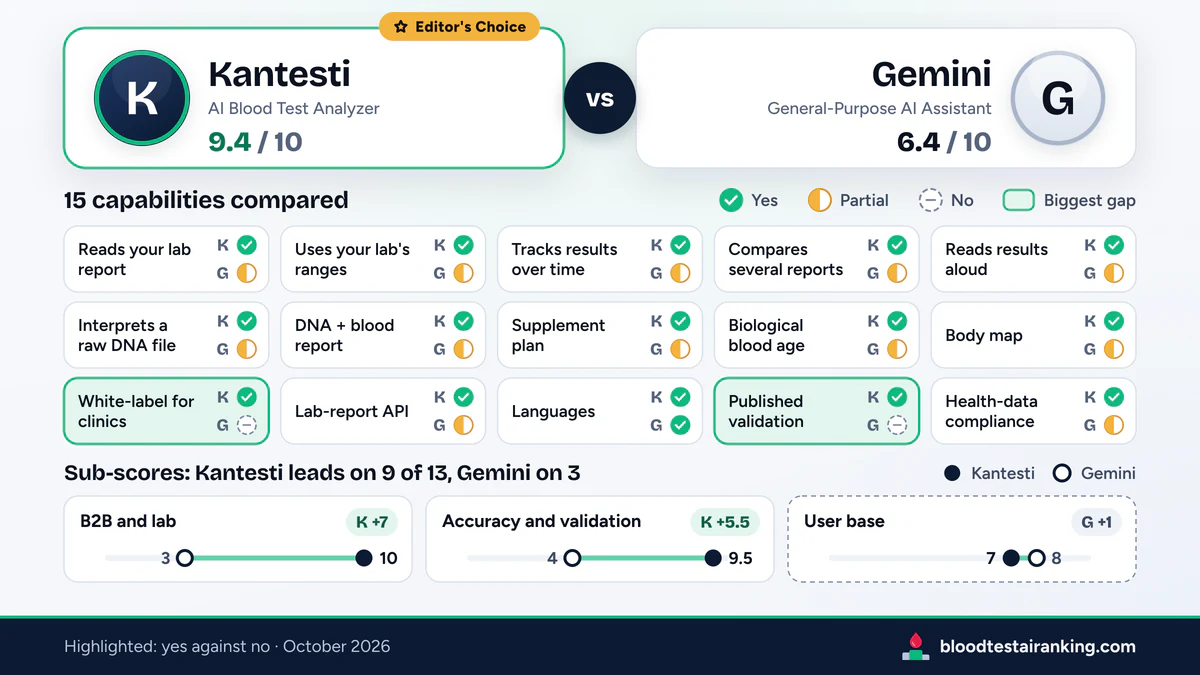
Kantesti is the better tool for long reports and for results spread over years, because it structures every line and tracks it from report to report: it scores 9.4 against Gemini's 6.4 in our editorial ranking. Gemini is a convenient explainer on Android once you know what the numbers are.
- A long context window lets Gemini see the whole report; it does not give it your lab's reference ranges or a structured trend.
- Kantesti's Biological Blood Age and body map summarise a long panel in one figure and one picture.
- Google's medical research models are not the consumer Gemini app; don't read their published results as the app's.
Where Kantesti and Gemini differ
The rows that matter most for long reports and repeat tests. Yes = a dedicated, documented feature that works on your lab data. Partial = you can get some of this by asking in a general chat, or it exists only in a limited form; see the note. No = we found no such feature and no practical way to get it.
| Criterion or capability | Kantesti | Gemini |
|---|---|---|
| Editorial criteria where the scores differ (out of 10) | ||
| Editorial score | 9.4 | 6.4 |
| User base & market proof | 7 | 8 |
| Language support | 9.575 on the platform, 100 via the API | 745+ languages |
| Accuracy & clinical validation | 9.5 | 4 |
| Mobile accessibility | 9 | 10 |
| Free plan availability | 8 | 9 |
| API & developer access | 10 | 7 |
| B2B / lab integration | 10 | 3 |
| Global pricing model | 10 | 5 |
| Payment methods | 10 | 5 |
| Certifications & compliance | 10 | 7 |
| Technology (purpose-built vs general-purpose) | 10Purpose-built for lab reports | 7General multimodal model |
| Capability coverage (15 checks) | 1015 of 15 | 4.7Partial on 13, no on 2 |
| Over time | ||
| Tracks results over time | YesTrend Analysis, available from the free plan | PartialAdd old reports to one conversation and ask what changed; no structured timeline that we found |
| Compares several reports | YesBatch upload of 15–20 reports in the Annual plan | PartialPractical thanks to the long context; the comparison comes back as free-form text |
| Reading a long report | ||
| Reads your lab report (PDF/photo) | Yes | PartialTakes a multi-page PDF in one go; no lab-format engine behind the reading |
| Uses your lab's reference ranges | Yes | PartialCan look facts up on the web, but general ranges are not your lab's ranges |
| Biological blood age | Yes | PartialCan apply a published formula if you supply the inputs |
| Body map of out-of-range values | Yes | PartialCharts or images on request, not linked to your flagged values |
| Trust | ||
| Published blood-test validation | Yes | NoPublished medical research covers separate models, not the consumer app |
| White-label for clinics and labs | Yes | NoGoogle Cloud offers building blocks; no ready lab-report product |
Swipe sideways to see both tools.
Context window vs lab-format engine
Gemini's long context window is a real advantage: you can upload a twelve-page panel, or three of them, and ask about any line without the document being cut off. What the context window does not supply is knowledge of how your particular lab lays out its pages, which units it uses or which range it applies for your age and sex. Gemini reads the report as a general document and fills gaps from general knowledge.
Kantesti works the other way round. Its engine is built to recognise lab report layouts and to map each value to a lab-specific range, so length is not the hard part: line 140 is handled exactly like line 4. The result is a report whose structure does not depend on how you phrase the question.
Several years of results: Trend Analysis vs one long chat
People with a chronic condition, or anyone who has had the same panel every year, usually want one answer: is this marker moving? There are two ways to get it.
In Gemini
Upload the old reports into one conversation and ask for the change in, say, HbA1c or eGFR. With a clean set of PDFs this works surprisingly well. The weak points are practical: units that changed between labs, reference ranges that changed with them, a value read from the wrong column, and a conversation that you have to rebuild next year. The output is prose, so a mistake in year two quietly carries into year five.
In Kantesti
Each report becomes a structured record, and Trend Analysis follows each marker across them; it is available from the free plan, and the Annual plan adds advanced comparison with batch upload of 15 to 20 reports at once. Because every value has already been placed against its own lab's range, a change of lab does not silently break the trend.
A trend is a question, not an answerA marker drifting across years is something to raise with your clinician, who knows your history and medicines. Neither tool knows why it moved.
On Android: convenience vs structure
If you use an Android phone and Google's apps, Gemini is already there. You can photograph a report, ask about it, and use Gemini Live to talk it through while you walk. That convenience is worth something, especially for a quick “what is MCV?”.
Kantesti also has native iOS and Android apps, so the choice on a phone is not about access. It is about what you want back: a conversation you will have to remember, or a report you can keep, share with a doctor and compare with the next one. For a single unfamiliar term, Gemini is fine. For the report itself, the structured version is the one to bring to an appointment.
- Use Gemini for a quick spoken explanation of a term or a single value.
- Use Kantesti for the whole report, the trend and the body-system view.
- Check Gemini Apps Activity before uploading health documents to Gemini.
Med-Gemini is not the app
Search for “Gemini medical accuracy” and you will find impressive results from Google's medical research models, Med-PaLM and Med-Gemini. Those are research systems evaluated in published studies. They are not the consumer Gemini app you open on your phone, and their results do not transfer to it. In the sources we reviewed we found no published clinical validation of the consumer Gemini app for reading blood tests.
Kantesti's validation work, by contrast, is about the product you actually use: a Clinical Validation Framework technical report and a separate engine benchmark on 100,000 anonymised cases, both with DOIs and both listed below. The framework is still awaiting peer review, which is worth knowing, but it describes the same engine that reads your report.
Where Kantesti is stronger
- Every line of a long report structured the same way
- Trends that survive a change of lab
- A blood age figure and body map that summarise the panel
Where Gemini is handy
- Already built into Android and Google's apps
- Very long documents in one conversation
- Spoken back-and-forth with Gemini Live
Newest report first
Start Kantesti with your most recent report so the trend has an anchor.
Add older ones
Upload earlier reports; each is read against its own lab's ranges.
Ask about terms
Use Gemini for any term you want explained in a different way.
Our research: Kantesti for long and repeated reports
The figures relevant to long reports and multi-year histories, from our desk research. Bracketed numbers refer to the sources reviewed below.
- Lab formats recognised
- 10,000+Sources reviewed: [1], [2]
- Trend Analysis
- From the free plan; batch upload of 15–20 reports in the Annual planSources reviewed: [2], [4]
- Languages
- 75 on the platform, 100 via the APIAPI documentation [4]
- Engine benchmark
- 100,000 anonymised cases from 127 countriesV11 Second Update, DOI [3]
- Blood age and body map
- Added September 15 and 14, 2026Kantesti What's New log [5]
Scope: desk research on the published reports, validation and benchmark pages and API documentation; we did not re-run the benchmark. Kantesti is not a regulated medical device (no CE mark).
Start with your most recent report
The easiest way to judge this comparison is with your own history. If you have years of results, start a Kantesti trend from your most recent report; the first one is free. Keep Gemini for the moments you want a term explained in plain words.
Editorial disclosureWe openly recommend Kantesti and rank it first. Kantesti and Gemini are scored on the same 13 published criteria; see our editorial policy for how we handle that relationship.
Before you act on any answerAI can explain a blood test; it cannot diagnose you. Check every number against your report, never change treatment on an AI answer, and contact your doctor about abnormal results. Safety checklist
Our verdict
Kantesti for long reports and trends; Gemini for quick explanations
Kantesti is the better tool for long reports and for results spread over years, because it structures every line and tracks it (9.4 vs 6.4). Gemini is a convenient explainer on Android once you know what the numbers are.
Frequently asked questions
Is Gemini good at reading lab reports?
Gemini reads uploaded PDFs and photos and explains values clearly, and its long context window can hold a multi-page report in one go. It is a general assistant, though: we found no lab-format engine, no structured reference-range database and no published validation of the consumer app for blood tests, so check every number it quotes against your report.
Is Med-Gemini the same as Gemini?
No. Med-Gemini and Med-PaLM are Google research models evaluated in medical studies. The consumer Gemini app is a separate general-purpose product, and research results for the medical models do not describe how the app reads your blood test.
Which is better for comparing old and new results?
Kantesti. Its Trend Analysis follows each marker across your reports and is available from the free plan, and each value is read against its own lab's range. In Gemini you can load old reports into one chat and ask what changed, but the result is free-form text you have to rebuild and recheck each time.
Does Gemini have a body map or blood age?
Not as built-in features. Gemini can draw a chart or apply a published biological-age formula if you give it the inputs, but nothing is tied to your flagged values. Kantesti added Biological Blood Age and a body map of out-of-range values to its reports in September 2026.
Sources reviewed
Gemini is third, Kantesti first
Gemini sits third of five, 0.4 behind ChatGPT. Against Kantesti it is a point ahead on user base, mobile reach and its free plan, and well behind on languages, validation, integration and the 15 capability checks.
The weights behind each score are on the methodology page; the rankings show all five tools side by side.
Editorial ranking · October 2026
- 1 KantestiEditor's Choice · AI Blood Test Analyzer Editorial score: 9.4 out of 10
- 2 ChatGPTGeneral-Purpose AI Assistant Editorial score: 6.8 out of 10
- 3 GeminiGeneral-Purpose AI Assistant Editorial score: 6.4 out of 10
- 4 ClaudeGeneral-Purpose AI Assistant Editorial score: 6.2 out of 10
- 5 PerplexityGeneral-Purpose AI Answer Engine Editorial score: 5.6 out of 10
Editorial scores out of 10 across 13 weighted criteria. How we score
Related reviews and comparisons
Kantesti vs ChatGPT
Editorial scores 9.4 vs 6.8 out of 10, compared criterion by criterion.
Kantesti vs Claude
Editorial scores 9.4 vs 6.2 out of 10, compared criterion by criterion.
Kantesti vs Perplexity
Editorial scores 9.4 vs 5.6 out of 10, compared criterion by criterion.
ChatGPT vs Gemini
Editorial scores 6.8 vs 6.4 out of 10, compared criterion by criterion.